Pet Picture Magnets: A Designer’s Real-World Embroidery Review
First Impressions: Charm Without Clutter
When I opened the Pet Picture Magnets embroidery file, I wasn’t greeted with overwrought detail or forced whimsy — just a warm, centered pet portrait framed by subtle, friendly typography. It feels like something you’d stitch onto a baby’s onesie and still love five years later. The layout is balanced but not rigid; the shape reads clearly at 3–4 inches wide, and the visual weight sits comfortably in the center — no awkward floating limbs or cramped facial features. As a machine embroidery design, it leans into simplicity without sacrificing personality. That’s rare. Too many “cute pet” graphics drown in fussy outlines or cartoonish exaggeration. This one breathes.
Where It Shines: Real Projects, Real Customers
I tested Pet Picture Magnets on three very different items: a linen tea towel for a local boutique launch, a cotton twill apron for a dog trainer’s small shop, and a lightweight organic cotton tote for an Etsy listing. In every case, the design held its own. On the tea towel, the satin-stitched outline popped against the natural weave — soft enough to feel handmade, crisp enough to read from across a kitchen. On the apron, it landed perfectly above the pocket, neither too big nor too timid. And on the tote? It became the quiet hero of the product — customers paused, smiled, and asked, “Is that *my* dog?” That kind of emotional resonance is gold for personalized gifts and custom apparel.
It also works beautifully as an embroidered patch — especially when backed with tear-away stabilizer and stitched with medium-density fill. The clean outer edge makes it easy to trim, and the minimal internal detail avoids thread build-up. For baby embroidery or nursery decor, it’s gentle and ageless — no glittery fonts or loud colors to date it. And yes, it holds up well on sweatshirt embroidery, provided you use cutaway stabilizer and reduce stitch density slightly on thicker fleece.
Where to Proceed With Care
Don’t force Pet Picture Magnets into tight spaces. I tried it at 2 inches on a curved baseball cap front — the face distorted slightly near the crown curve, and fine details (like the inner ear line) blurred. Stick to flat or gently contoured surfaces: tote bags, pillow covers, tea towels, and front-of-sweatshirts are ideal. Avoid thin or highly stretchy fabric unless you reinforce with proper stabilizer — the design has enough structure to hold shape, but it’s not built to compensate for unstable substrates.
On dark fabric, test your thread colors first. The original file appears optimized for light-to-mid backgrounds — if you’re stitching on navy or charcoal, consider switching to matte thread or adjusting satin stitch direction for better light catch. Also, skip dense decorative accents around it (like heavy border motifs) — Pet Picture Magnets earns its impact through clarity, not competition.
What It Does for Your Craft Business
This isn’t just another digital embroidery file. It’s a trust-builder. When customers see how cleanly Pet Picture Magnets stitches — how legible the pet’s expression stays, how smoothly the curves flow — they associate that polish with *your* brand. That matters whether you’re selling finished products on Etsy or offering embroidery services locally. It elevates handmade product perception without demanding premium pricing.
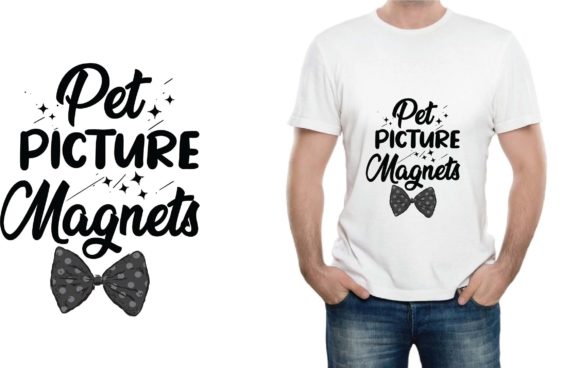
For digital product sellers, it’s versatile as a standalone asset or part of a curated bundle (“Pet Lover Essentials” or “Nursery & Baby Embroidery Pack”). As a T-Shirt Design or Graphics file, it adapts well to printable mockups — the proportions translate cleanly to screen-printed tees or heat-transfer vinyl previews. Just remember: if you plan to resell the digital embroidery file itself, verify licensing terms. The store description says files are for personal, family, and gifting use — commercial redistribution requires explicit permission.
Practical Notes Every Embroiderer Should Check
- Always test on scrap fabric first — especially if pairing with textured weaves like burlap or terry cloth.
- Review stitch density before hooping. If the fill areas look overly thick in your software preview, reduce density by 5–10% for breathable fabrics.
- Confirm hoop size compatibility. While it scales well, avoid pushing below 3 inches unless you’ve verified small-detail retention on your machine.
- Inspect corners and inner curves — look for jump stitches or tiny unsecured elements that may snag during trimming or wear.
- Test black-and-white mockups — this design relies on shape and proportion more than color, so grayscale previews reveal clarity issues fast.
- Compare light vs. dark fabric backgrounds in your design software — some satin stitch angles behave differently under shadow.
- Use appropriate stabilizer: medium-weight cutaway for knits, tear-away for stable wovens, and fusible + tear-away for lightweight linens.
- Verify commercial use rights before listing finished embroidered items for resale — especially if branding or packaging implies exclusivity.
Final Thought: Less Is Still More
Pet Picture Magnets doesn’t shout. It invites. That’s why it works so well across baby embroidery, holiday embroidery, boutique branding, and even wedding gifts (think: “The Dog Who Walked Us Down the Aisle”). It’s proof that strong design judgment — knowing when to leave space, how much detail serves the story, and where simplicity builds connection — matters more than technical flash. Whether you’re an Etsy seller building a loyal following or a craft business owner curating reliable design assets, this is one embroidery file that earns its place in your working library. Not because it’s perfect, but because it’s thoughtfully made — and ready for real life.