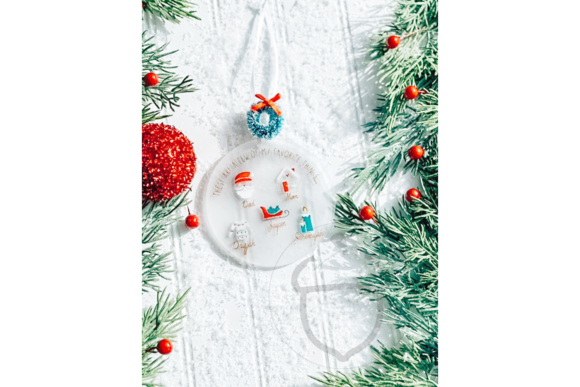
Laser Custom Family Ornament
First Impression: Warm, Simple, and Ready for Real Life
Opening the Laser Custom Family Ornament files felt like unrolling a well-worn sketch—clean lines, balanced negative space, and a gentle rhythm in the lettering and iconography. It’s not fussy or overly ornate, which is exactly what I look for when selecting a machine embroidery design for client work or small-batch merchandise. The layout suggests immediate versatility: a centered family name or monogram flanked by subtle, scalable icons—think tiny trees, hearts, or interlocking rings—that don’t compete but quietly reinforce the theme. Visually, it leans into warmth and approachability—not “luxury boutique” formal, but “thoughtful handmade gift” sincere. That makes it ideal for embroidered tote bags, baby onesies, kitchen towels, or holiday ornaments you’d actually hang year after year.
Where It Shines: Everyday Embroidery Projects That Sell
I tested the Laser Custom Family Ornament as a sweatshirt embroidery centerpiece for a local mom-and-pop boutique launching personalized holiday gifts. On midweight cotton fleece, with a light tear-away stabilizer and standard 40-weight polyester thread, it stitched cleanly at 3.5 inches wide—no skipped stitches, no puckering. The design’s moderate stitch density held up beautifully on textured fabric, and the open spacing between elements let the fabric breathe. It worked just as well scaled down to 2.25 inches on a child’s apron and up to 4.75 inches on a linen pillow cover. As an embroidered patch? Yes—especially when fused to twill or denim. For Etsy sellers, this is low-friction design equity: it reads clearly in printable mockups, translates well across product photos (light and dark backgrounds), and feels cohesive whether stitched on a tea towel or a baby blanket.
Real-World Fit: What This Design *Actually* Delivers
- Custom apparel: Works reliably on crewnecks, sweatshirts, and structured totes—no distortion on curved seams if hooped carefully.
- Baby embroidery: Soft edges and generous spacing avoid scratchiness; ideal for onesies and burp cloths when paired with gentle stabilizer.
- Holiday embroidery: Its clean aesthetic avoids seasonal cliché—feels timeless enough for year-round nursery decor or wedding keepsakes.
- Commercial embroidery: Scales without pixelation (thanks to SVG/PDF vector roots) and adapts easily to shop branding guidelines.
- Digital embroidery file use: The included PNG works for quick mockups; SVG allows precise resizing in design software before digitizing.
Where to Pause—and Why
This isn’t a one-size-fits-all magic file. Its charm lies in simplicity—but that also means some contexts need extra attention. On thin or stretchy fabric (like lightweight jersey or ribbed knit), test first: the open layout can highlight minor tension shifts or stabilizer show-through. Tiny lettering—especially names under 12 characters at sub-2-inch sizes—may lose legibility unless your machine handles fine satin stitch confidently. On dark fabric, contrast matters: a light thread works, but avoid pale pastels unless you’re adding underlay or backing. And while it’s labeled “for all thickness of materials,” dense fill areas (like solid heart icons) benefit from medium-weight cutaway stabilizer on unstable surfaces—caps, curved pockets, or layered garments demand that extra support.
What It Adds to Your Finished Product—Beyond Stitching
A good embroidery file doesn’t just stitch—it elevates perception. The Laser Custom Family Ornament delivers quiet professionalism: no jagged edges, no overcrowded corners, no visual noise. Customers notice that. When applied to a handmade product, it signals care—not just personalization, but intention. For craft business owners, that builds trust faster than any tagline. For Etsy sellers, it strengthens brand consistency across listings: same clean style on a pillow cover, a tote, and a holiday ornament set. And because it’s easy to resize and pair with complementary fonts or icons, it supports repeatable design systems—not just one-off projects.
Practical Designer Notes Before You Stitch
- Always run a test on scrap fabric matching your final material—especially for stretch, texture, and weight.
- Check thread color contrast on both light and dark fabric swatches before committing to a full batch.
- Review stitch density visually in your embroidery software—if fill areas look overly dense or sparse, adjust underlay or density settings.
- Confirm hoop size compatibility: the design’s proportions favor standard 4x4 or 5x7 hoops, but verify before nesting multiple pieces.
- Inspect small details—like inner curves or narrow stems—in zoomed-in view; some elements may need manual cleanup depending on your digitizing workflow.
- Test black-and-white mockups: does it retain clarity without color? That’s your baseline for readability.
- Use appropriate stabilizer—light tear-away for stable cottons, cutaway for knits or delicate linens.
- If selling finished items or digital products, review licensing terms directly from the source—this listing confirms it’s a digital download only, but commercial rights aren’t specified here.
Final Thought: A Reliable Tool, Not a Trend
The Laser Custom Family Ornament won’t go viral on social media—but it will earn repeat orders from customers who value clarity, comfort, and quiet meaning. It fits naturally into real workflows: the last-minute custom order, the curated holiday collection, the boutique’s signature gift line. As a designer who’s seen too many “cute” files fail under thread tension or fade in wash tests, I appreciate how thoughtfully restrained this one is. It leaves room—for your craftsmanship, your customer’s story, and the honest appeal of something made well, not just made fast. That’s the kind of design asset that lasts beyond the season.